Quantum-Enhanced Strategic Siting of Energy Storage and Microgrids
Energy Infrastructure
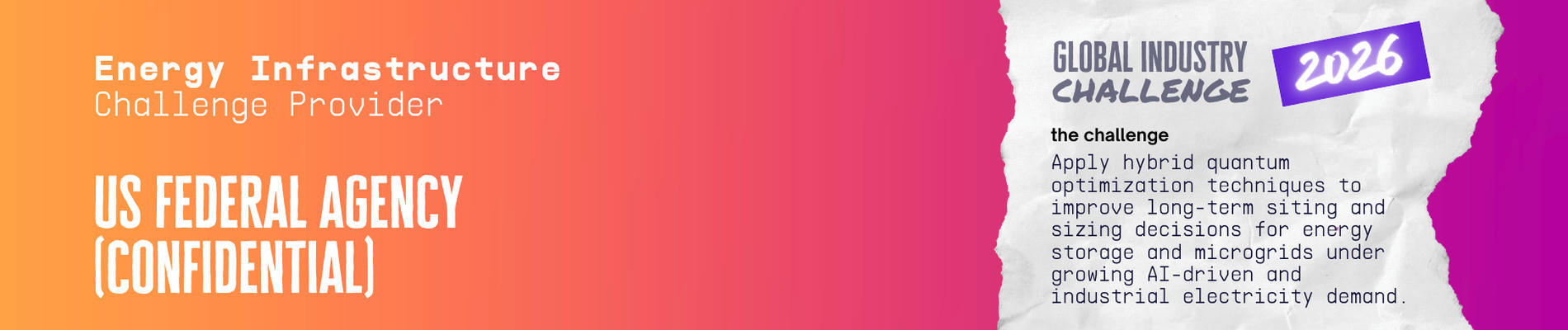
As electricity demand grows and the U.S. power system integrates data centers and large industrial loads, grid planners must strategically determine where to deploy energy storage systems and microgrids to maximize resilience, reliability, and economic efficiency over multi-year planning horizons. These siting and sizing decisions must account for load variability, generation variability, transmission constraints, contingency requirements, and varying weather risks, requiring evaluation of thousands of potential infrastructure configurations across diverse operating conditions. Participants will investigate quantum formulations of siting decisions, develop mappings to QUBO or variational optimization frameworks, and benchmark hybrid quantum approaches against established classical planning solvers. The objective is to determine where quantum methods may improve combinatorial search efficiency, scenario exploration, solution robustness, or investment trade-off analysis for critical energy infrastructure.
Phase 1 focuses on three things: building your team, selecting your Challenge track, and developing your initial concept.
Team Composition
The Global Industry Challenge is a collaborative competition; teams can be formed locally or internationally with between 1 and 5 teammates.
Find teammates here.
Join a team here.
Teams may have between 1 and 5 participants. We recommend 3 to 5 members to balance the workload effectively. Strong teams are diverse in skill. We encourage you to fill the following roles:
• Coder
• Data / Technical Lead
• Content / Domain Expert
• Business / Commercial Lead
• Project Manager / Team Coordinator
What do I submit for Phase 1?
Create a 1‑page (plus cover page) maximum PDF, using 11‑point Times New Roman font and single spacing, and submit it through the relevant Aqora Competition.
File Format Requirement: TeamName__Phase1_VersionX.pdf
Include the following details:
- Cover Page (not included in page count) GIC 2026 Cover Page.docx
- Team Qualifications for Tackling the Challenge (Education, Job Title and Organization)
- Brief Description of the Steps You Will Use to Solve this Challenge
- High‑level overview of your proposed solution
- Technical approach, including how you will utilize quantum computing feasibility and advantage over classical methods
- Projected industry impact
First Phase Submission Deadline: Sunday, April 5, 11:59 PM (EST).
Judging Criteria
Teams will be evaluated on two dimensions. First, technical proficiency: judges will assess the depth and quality of your team's quantum computing knowledge and execution capability. Second, a higher weight is placed on conceptual feasibility: your Phase 1 submission must define a credible, technically grounded approach that benchmarks quantum methods against classical baselines and articulates measurable industry impact.
As electricity demand grows and the U.S. power system integrates data centers and large loads, grid planners must strategically determine where to deploy energy storage systems and microgrids to maximize resilience, reliability, and economic efficiency. Optimal siting decisions must account for load variability, generation variability, transmission constraints, contingency requirements, and varying weather risks, while balancing capital investment and operational performance over multi-year planning horizons.
Energy storage and microgrid placement problems are typically formulated as large-scale mixed-integer optimization models with nonlinear power flow constraints and multi-scenario uncertainty. These problems require evaluating thousands of potential infrastructure configurations across diverse operating conditions, making them computationally intensive and increasingly complex as fast-varying loads proliferate.
This challenge explores how near-term quantum computing approaches—particularly hybrid quantum-classical optimization and heuristic methods—can enhance strategic infrastructure planning for storage and microgrid deployment. Participants will investigate quantum formulations of siting and sizing decisions, develop mappings to QUBO or variational optimization frameworks, and explore hybrid decomposition techniques for handling multi-scenario resilience constraints.
Teams will benchmark quantum and hybrid approaches against established classical planning solvers using realistic grid test systems and resilience-focused case studies. The objective is not to replace classical tools, but to determine where quantum methods may improve combinatorial search efficiency, scenario exploration, solution robustness, or investment trade-off analysis.
Outcomes of this challenge have direct implications for accelerating new load integration, improving grid hardening strategies, enabling community-level resilience through microgrids, and strengthening U.S. energy security and infrastructure competitiveness.